


Older listeners · ages 9–12 · comfortable from 8 with a grown-up · Retold from the Panchatantra
A heads-up: three friends die in this story, stated plainly and without detail, and there is no rescue for them.
Reading aloud? A note for you
Three friends die here, offstage and without physical detail — the story states it plainly and moves on, the way the old telling does. Slow down on the sensible friend’s warning and on how calmly he climbs the tree; the story trusts his plain sense more than it trusts the scholars’ cleverness, and it helps if your voice trusts him too. Your listener may ask why the other three didn’t just listen to him — that’s the exact question this story wants asked, and you don’t need to answer it for them. There’s no rescue and no do-over in this one; if that feels sudden on a first listen, that’s the sting doing its job.
Dev had spent most of the afternoon folding a paper crane, following every crease exactly the way the diagram showed, and it still wouldn’t fly — it only spiraled straight down. Leo’s plain, lopsided paper airplane, folded in four seconds flat, had sailed clean across the yard twice. Dev brought the ruined crane along anyway, turning it over in his hands, unwilling to admit defeat on it just yet.
Mira, settling in beside him, was the one who suspected tonight’s story might be a good one before anyone had even started. “Is it a scary one?”
“It has three deaths in it,” said Nani, plainly, “so — yes, a little.”
Leo whooped and pretended to fall backward off the root, catching himself at the last second, which made Dev, still fiddling with his crane, shift a careful half-inch closer to Nani’s side.
“It isn’t a story about a monster, though,” Nani went on. “It’s a story two travelers told each other on a long road, arguing which was worth more — years of hard-won learning, or plain, ordinary sense. One told this tale to make his case: learning, without sense to guide it, can be dangerous.” She glanced at Dev’s crooked-winged crane. “Watch this one, Dev. It has a bit of your afternoon in it.”
“Listen.”
Four friends lived in the same town and had grown up together, close as brothers. Three of them had spent years at their studies and knew a great deal — old poems, careful arguments, the proper way to build a case out of nothing but words. But knowing a great deal is not the same as knowing what to do with it, and none of the three had much sense for the ordinary, everyday business of living. The fourth friend had never cared for books at all. What he carried instead was plain sense — the useful, unglamorous kind that simply notices what is actually happening in front of it, and trusts what it notices.
One evening the four of them sat talking about their future. “What good is all our learning,” said the three who had studied, turning the question over between them, “if we never put it to use and make something of ourselves? Let’s travel together, find a king who values what we know, and build our fortunes in his service.”
The fourth friend, the one with sense, listened to all of this and simply nodded — he had never much cared what kind of fortune he made, only about doing whatever he did carefully. So it was agreed, and they set out on the road together the next morning. But they had not walked very far before two of the three scholars fell to muttering between themselves about the fourth. “He hasn’t studied a page in his life,” one said, low enough that he thought his friend wouldn’t hear. “What king is going to reward a man who brings nothing but common sense to his court? Better we leave him here and travel on without him — why should he share equally in what we three have earned by years of hard work?”
The third scholar wouldn’t have it. “We were children together,” he said firmly. “We share what comes our way, the same as we always have. He comes with us, and that’s the end of it.”
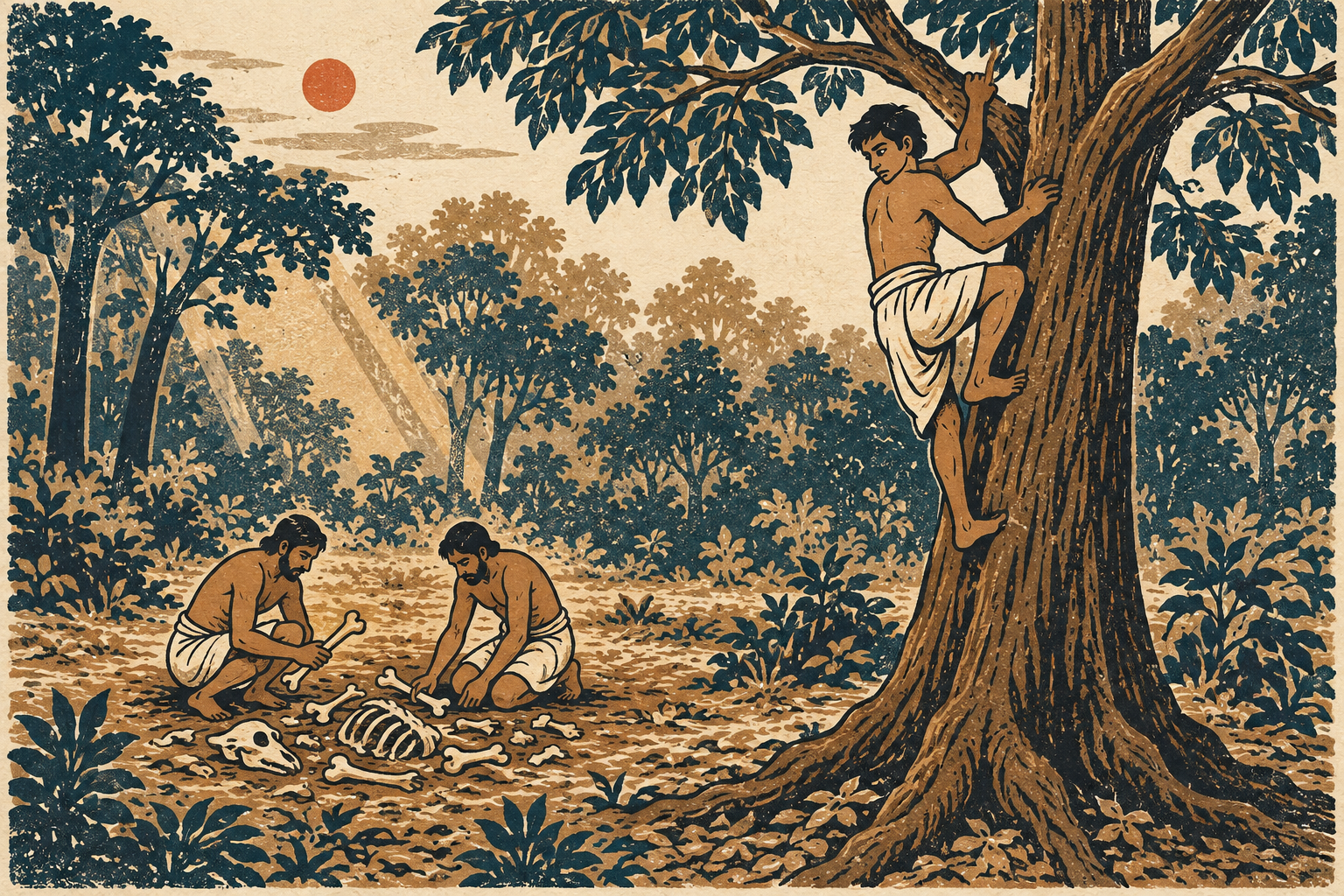
So the four of them went on together, as they always had. Before long their road carried them into a forest, and there, half buried under fallen leaves, they came across a scattered lion’s skeleton — old bones, long picked clean, all that remained of some creature that had died there seasons before.
One of the scholars crouched down beside the bones, turning one over in his hands. Then he straightened up, eyes bright. “Here’s our chance,” he said. “A perfect test of everything the three of us have studied all these years. Between us, we know enough to build this creature whole again, and call the breath of life back into it.”
The second scholar knelt beside him. “I can set the bones back together properly, joint by joint, exactly as the old texts describe it.”
“And I can build the flesh over them,” said the third, “skin and blood and all, until it looks as it once did, living.”
“Then I will be the one to call life into it, once you two are finished,” said the first, already reaching for the nearest bone.
They set to work right away, each one absorbed in the skill he was so proud to be showing his friends — one piecing the skeleton together bone by bone until it stood the right shape again, the other layering flesh and hide over it with careful hands, both of them talking as they worked about how well the old lessons were serving them now. Birds went quiet in the branches overhead. The afternoon light slanted low through the trees, and dust rose where the two scholars knelt over their work, so absorbed that neither one looked up.
Their friend with sense had said nothing so far. He had simply watched, arms folded, as the shape of a lion slowly took form on the forest floor in front of him. Now, as the second scholar stepped back to admire the finished body, he spoke up plainly. “Think for a moment about what you’re doing here. If that creature wakes, it will not be a study project. It will be a real lion, and lions kill people. There is nothing in this forest to stop it from killing the three of you the moment it opens its eyes.”
The scholar who was about to call the life into the beast only laughed at him. “You’ve never opened a book in your life. You don’t get to stand there and tell scholars where their own scholarship should stop.”
“Have it your way, then,” said the friend with sense, unbothered. “But if it’s all the same to you, I’ll be up in that tree while you finish your work.” And without another word he walked to the nearest tall tree, climbed steadily up through its branches, and settled himself high above the ground to watch and wait.
The scholar went ahead anyway, and called the breath of life into the lion.
And it worked exactly as he had hoped. The great body on the forest floor stirred, then gathered itself, then rose to its feet — fully alive now, fully a lion, and with nothing scholarly left about it at all. It looked once around itself at the three friends standing closest, and then it turned on them. By the time it was finished, not one of the three who had built it was left standing. Then, its business in that clearing done, the lion padded off silently between the trees and was gone from sight.
Only once the forest had settled back into stillness did the friend with sense climb down from his branch. He stood a moment beside what was left of the clearing, taking in what had happened there, and then he turned and walked the long road home alone that evening, whole and entirely unhurt, carrying nothing with him but the plain sense that had kept him alive — and he never once wished, walking that road, that he had studied more instead of watching so carefully.
Here, under our tree, nobody spoke for a moment. It was Leo who finally broke the quiet. “He just — climbed a tree? That’s really it? That’s how he was the only one who lived?”
“That’s really it,” said Nani, and left it there.
Dev looked down at his ruined paper crane a while, turning it slowly in his hands. “The other three knew more than him about almost everything,” he said, quiet, almost to himself.
Nani only nodded, and didn’t add a word to it. Beside her, Bupam reached over and, very carefully, straightened one bent wing of the fallen crane with two fingers, as if it might still be worth trying again.
For the grown-up (not read aloud): the heart of it — knowledge without sense to guide it can be dangerous, and noticing what’s actually true in front of you matters more than knowing the most.
Where it comes from: retold from the Panchatantra (the scholars who brought a lion back to life, Book 5).
More stories for ages 9–12
The Guardian by the Cradle · The Monkey’s High Branch · The Frog King’s Bargain · Called Back Twice · The Judge Who Could Not Hear · The Narrow Way Out
 Banyan Story Studio