


Older listeners · ages 9–12 · comfortable from 8 with a grown-up · Retold from the Panchatantra
A heads-up: a boy is bitten by a snake after he tries to strike it first, and he does not live — the story says so plainly, in a line or two, and moves on.
Reading aloud? A note for you
The boy’s death is told in one short sentence, not acted out — read that sentence steadily and let a breath sit after it before you go on to the father. A child may ask whether the snake was “bad,” or why the father goes back to the anthill at all; both are worth sitting with rather than answering quickly, since the story itself doesn’t resolve either one fully. We left out one line the father says on his return, in which he blames his own son’s cleverness for the death — the source has it, but the studio does not carry it to children. Everything else — the milk, the gold, the boy’s own plan with the cudgel, and the snake’s last words about love and its scars — stays as the source has it. Haridatta is said huh-ree-DUT-tuh.
Mira had brought out a whole tangle of hair ribbons that evening, sorting them into piles by color on the flat root beside her — reds together, then blues, then a stubborn knot of two colors twisted so tight she set it aside for later. Leo watched for a while, then lost interest and went to sit down properly. Dev never did join the sorting; he simply appeared at Nani’s side, settled, and glanced once at the pile of ribbons before looking away.
“In the owls’ court, the counsellors argued back and forth, and told these tales as they argued,” Nani said. “Tonight’s is about a Brahman and a snake who lived side by side in something like trust for a long while — and what happened when that trust broke, without anyone quite meaning it to.”
“Listen.” And she began.
In a certain village there lived a Brahman named Haridatta, who worked a field that gave him back less than he put into it, year after year, no matter how early he rose or how late he stopped at dusk. He turned the soil, he watered what could be watered, he watched the sky for rain that came late or not at all, and still the harvest was thin, season after season, until he had almost stopped expecting anything else from that ground.
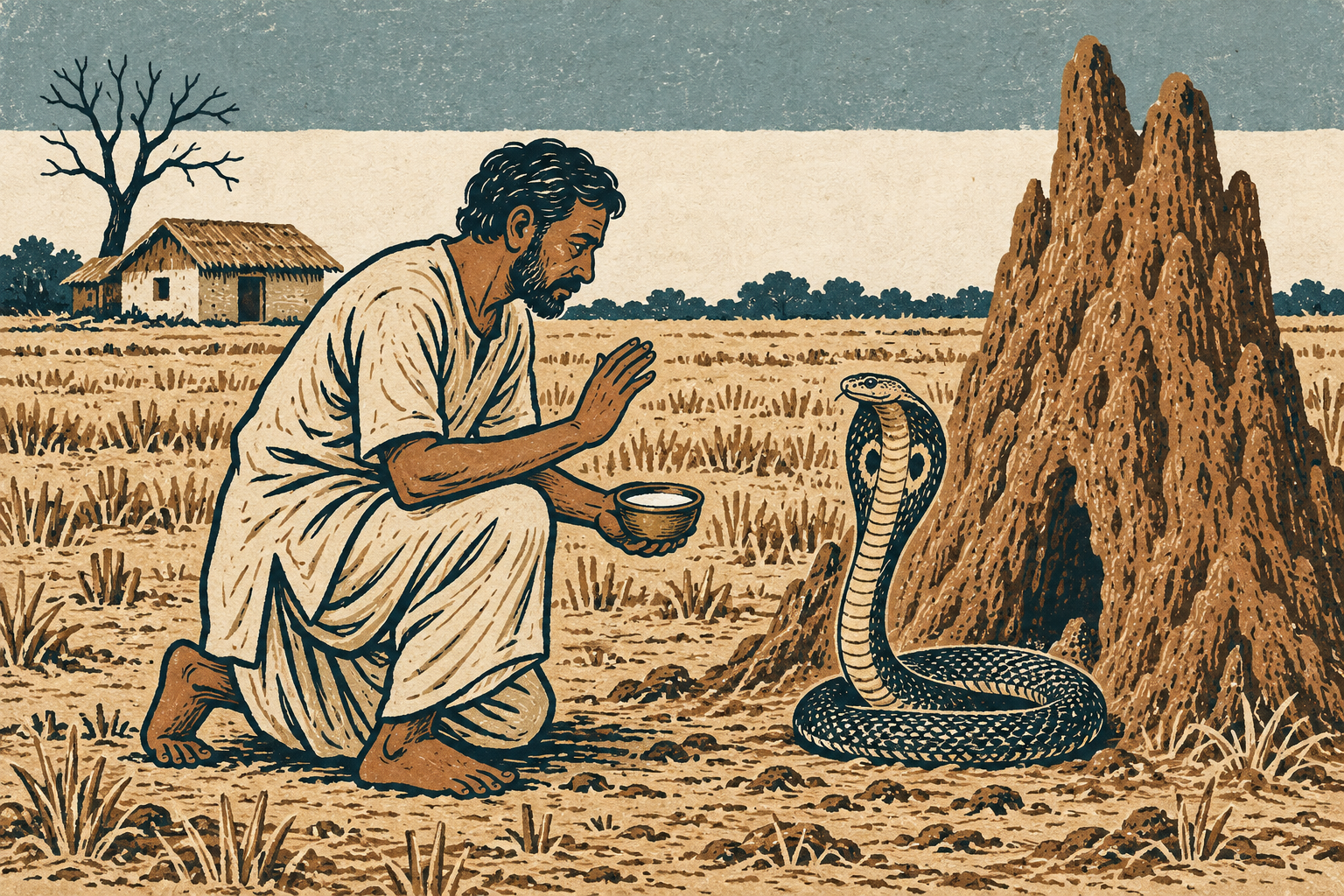
One hot afternoon near the end of the growing season, worn out with the sun and the poor return of it all, he sat down to rest in the shade at the field’s edge. And there, at the mouth of a low mound of earth not far off — the kind of mound ants build up over years, packed hard and riddled with tunnels — he saw a great snake lift its head and spread the skin at its neck wide, watching him without moving closer.
Haridatta had never once, in all his years working that field, thought to give that mound any honor at all. It had simply always been there, the way a stone or an old tree is always there, until you are made, suddenly, to look at it properly. Now, tired and a little afraid, a thought came to him: perhaps this creature keeps the field, and my luck has gone bad all this time because I never once paid my respects to it.
So that evening he begged a cup of milk from a neighbor, carried it out to the mound in the last of the light, and set it down at the entrance. “I did not know you were here all this time,” he said to the snake, “or I would have honored you long before now. Be kind to my field, and to me.” Then he went home and thought no more of it that night.
In the morning, when he came back to fetch the cup, he found a gold coin lying in it, bright against the empty bottom where the milk had been. He stood a long while looking at it before he picked it up. From then on he went to the mound every single day with a fresh cup of milk, and every single morning he came home with a coin in his hand.
This went on for a good while — long enough that Haridatta stopped being surprised by it, and simply built the walk out to the mound into his days, the way you build in a habit you’ve come to trust. Then one day he had business that kept him in the town overnight, and rather than break the custom, he sent his son out with the milk instead, telling him only to set it down at the mound’s mouth and come straight back, nothing more.
The boy did exactly as he was told, that first evening. But the next morning, when he went out again on his own and found a single coin waiting in the empty cup, a thought took hold of him that his father, in all those months, had never once let himself think. If one small visit brought one coin, the boy reasoned, then the mound itself must hold a great many more — heaped up somewhere under all that packed earth — and the snake was nothing but a guard standing between him and the rest of it.
So the following evening the boy went out to the mound carrying a stick along with the milk, and when the snake lifted its head as it always did, he struck at it as hard as he could, meaning to finish it before it could do him any harm.
The blow did not kill the snake. What it did was turn a creature that had asked for nothing more than a little honor and a little milk into one defending its own life in the only moment it had to defend it — and it struck back, quick and sure. The boy did not survive the day.
His family found him where he had fallen, not far from the mound, and did what needed doing for him that same evening. And when Haridatta came home the next day and was told what had happened, he did not need to be told twice to understand what his son must have tried, and why he had tried it.
Once he could speak of it at all, what he said was that generosity toward any living creature is a thing worth keeping — whatever it may cost you — because turning away a guest, a stranger, or anyone who comes to you in trust can cost you everything you have in return, even the things you never meant to risk. When his neighbors, sitting with him that night, asked how he had come to believe such a thing so surely, he answered them only with another old story he had once been told — about a flock of golden swans who lost their whole home on a lake because they would not make room for one bird more — and said no further word about his own loss that evening.
Then, in the grey of the following morning, Haridatta took up the milk cup once more, filled it as he always had, and walked out to the mound.
He called out as he came near, wanting the snake to know his voice and not be startled by it. He knelt, as he always had, and set the milk down at the mound’s mouth.
The snake came to the entrance, as it always had. It answered him at last. What is broken and then mended, it said, is never again quite the same shape it was before; you can build a burned place back up, board by board, but the ground beneath it goes on remembering the fire long after the smoke has cleared.
Here, under our tree, Dev glanced once toward the pile of sorted ribbons, and didn’t say anything about them.
“But they were — something. After. Even though,” Dev said at last, low.
“Something,” Nani agreed, and rested her hand briefly on his hair.
Mira turned it over a moment longer. “I don’t think I’d have gone back,” she said, “if I were the snake.”
“Maybe that’s why the story remembers this one,” Nani said, “and not some ordinary morning when nothing was ever broken.”
For the grown-up (not read aloud): the heart of it — even a badly broken trust can be partly mended, though never made whole again, and the ache of the break stays even after the mending.
Where it comes from: retold from the Panchatantra (the story of the Brahman and the snake at the anthill, Book 3).
More stories for ages 9–12
The Judge Who Could Not Hear · The Narrow Way Out · The Monkey’s High Branch · The Frog King’s Bargain · Called Back Twice · The Friend Who Climbed the Tree
 Banyan Story Studio