


Older listeners · ages 9–12 · comfortable from 8 with a grown-up · Retold from the Panchatantra
A heads-up: a father in this story loses his son to the very danger he invited in — it happens off the page, stated once and never shown, but it is the story’s turning point.
Reading aloud? A note for you
This one is built for the older end of the tree, and it earns its place there. A father sets out to punish his relatives and ends up costing himself far more than he bargained for — including, at the story’s hardest turn, his own son. In the old telling, the snake and the frog king each keep their own name, and the snake works through the frog king’s family one by one, in detail; here we’ve kept it to a single bargain, and let one line — the snake did what he’d asked, and more — carry the cost, so the story never lingers where it doesn’t need to. The son’s loss is named once, plainly, in a single sentence, and the story moves straight on; most children won’t ask for more than that, and there’s nothing more to give them if they do. If anyone asks why the frog king won’t go back at the end, that refusal is the story’s answer — he has learned something true about the snake, and he doesn’t unlearn it for a kind message and a promise.
The frogs down at the tank had started up all at once that evening, a ragged chorus of them croaking over each other in the dark, loud enough that Leo had to raise his voice to be heard over it. “There must be hundreds down there,” he said.
Mira had brought a pencil to catch tonight’s story on paper before it got away, and sat with it balanced behind her ear, only half listening to the noise. Dev, tonight, sat closer than usual, shoulder against Nani’s arm, and said nothing at all — which was how she knew it had been one of those days. Bupam, part-way down the trunk on some errand of his own, stopped to listen too.
“Fitting, all that croaking,” Nani said. “This is one of the stories a monkey once told a crocodile, back on a night when the two of them were still working out whether they could really be friends. It’s about what can happen when the friend you go looking for turns out more dangerous than the trouble you started with — and the strength it takes to walk away from him, once, for good.”
Mira’s pencil stopped. “Is it a happy one?”
“It ends the way it needs to end,” Nani said. “Listen.” And she began.
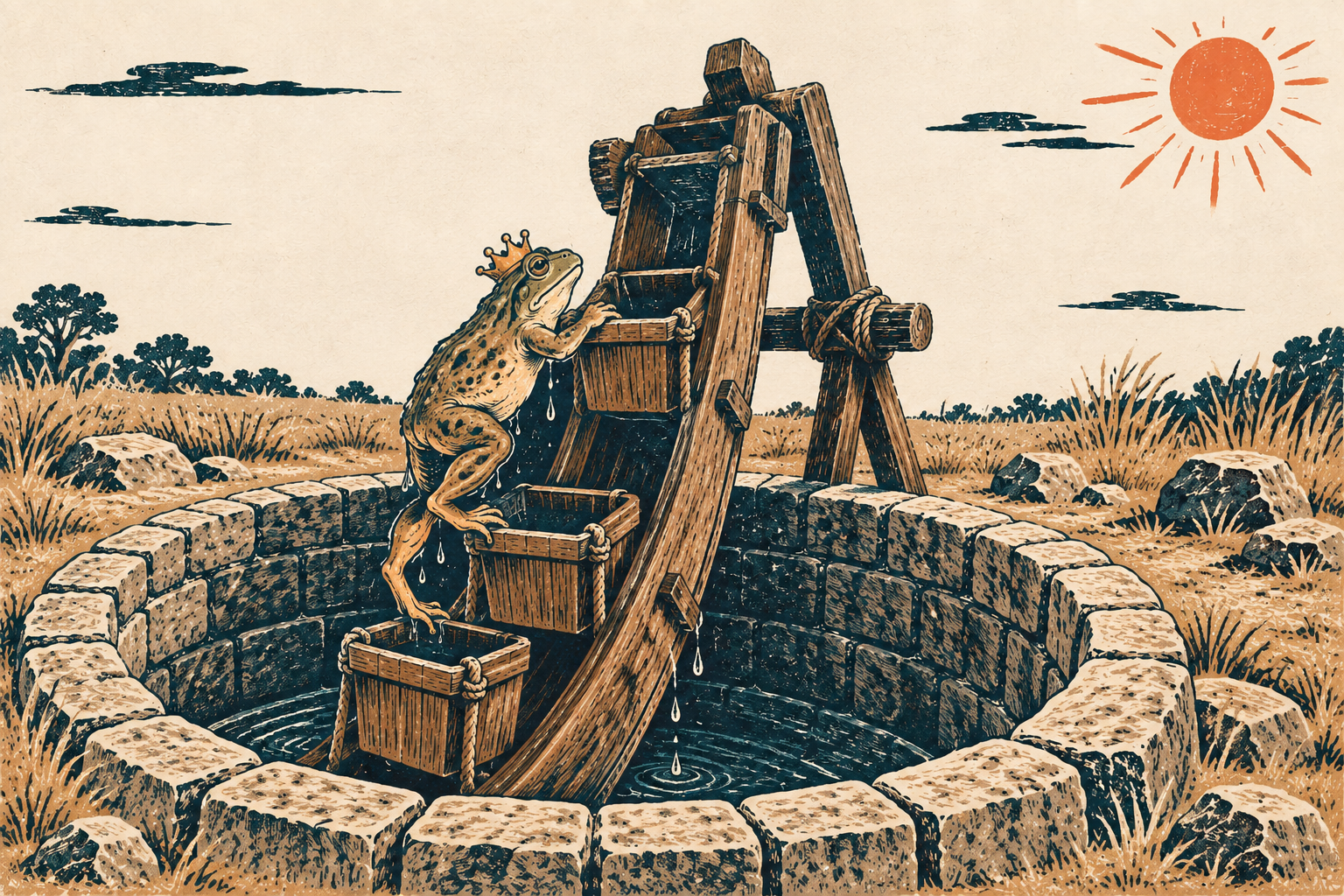
Long ago, down inside a well, lived a frog-king who spent his whole life there, and the name the old tellings give him was Gangadatta.
His relatives made his days miserable — teasing, mocking, wearing him down the particular way that only family can — until one morning he decided he had taken enough of it. He climbed out of the well the hard way, hand over hand up the wheel that drew its water, bucket by bucket, all the way to the sunlit rim, thinking the whole climb up: I will find a way to pay them back for this.
At the top he came upon a black snake, coiled and sunning himself at the mouth of a burrow nearby, and a plan formed in the frog-king’s mind at the very sight of him. A snake, he reasoned, was exactly the kind of enemy his relatives deserved — and exactly the kind of ally a clever, desperate frog might use once and be rid of. So he approached and called out a greeting.
The snake did not answer right away. He lifted his head only a little and studied the small stranger with an old, unhurried caution, the way a creature that has survived a long time studies anything new. “Whoever you are,” he said at last, “we are not friends by nature, you and I. Explain yourself before I decide whether to be interested.”
So the frog-king explained: who he was, what his family had put him through, and what he had climbed all the way out of the well to arrange. He offered the snake safe passage into the well and free run of his relatives — every one the frog-king pointed out, and no others — asking nothing in return but the visit itself.
The snake turned the offer over slowly, the way an old, hungry, careful creature does. He was past his best hunting years now — a mouse caught here and there, and often not even that — and a well full of easy, waiting frogs was not a thing to refuse lightly, plan or no plan. Still, he hesitated. “And how am I meant to get in,” he asked, “and where would I even lie, once I did?”
“There is a wheel,” said the frog-king, “that draws the water up, bucket over bucket. It will carry you down as easily as it carries water up. And there is a hollow at the waterline, dry and quiet, exactly the right size for you to rest in between meals. I have already thought of everything. All I ask is that you spare the ones I don’t point out.”
“Lead the way, then,” the snake said at last. “We’ll go together. But mark this — you point out who I may take, and I take no one else. Agree to nothing more than that, and I’ll agree to nothing less.”
The frog-king agreed at once, relieved almost to tears to have found him.
He led the snake down through the wheel and its buckets into the cool dark of the well, and showed him the hollow at the waterline, just as he’d described it. And there, exactly as promised, the snake set to work on the frog-king’s tormentors.
It should have ended there. It did not.
Once the last of the relatives were gone, the snake did what the frog-king had asked of him — and then a good deal more. He worked his way through the frog-king’s friends next, carefully, unhurried, and when even those ran thin he turned to the frog-king himself and said, not unkindly, that he had nowhere left to go — his own burrow was surely taken by now by some stranger — and that he intended to stay exactly where he was, in the well, for good. “You will bring me a frog a day,” he said, “even one of your own household, if it comes to that. If you don’t, I will simply take whoever I please, until there is no one left at all.”
The frog-king was sick with what he had done, but he could see no way out of it that did not cost him more. A snake that size, coiled in the one hollow that led to safety and water both, was not a thing a frog could simply refuse. So, day by day, he chose — a cousin one evening, an old family friend the next, each choice a small, private grief he carried alone, because there was no one left to share it with who wasn’t also afraid. And behind his back, uncounted, the snake began taking more than his one — a habit easier to start than to stop, once a promise has already been broken once.
Then came the day the snake, working through the household as he always did, took the frog-king’s own son.
The frog-king heard it happen and cried out, a high, broken sound that carried up through the well.
There was no one left to spare after that. In time, when the last of his own kind but himself had gone the same way, he went to the snake with a new offer: let him leave the well, just for a while, to search out other wells, other frogs, more to bring home. The snake, who by now trusted him the way a creature trusts what has fed it faithfully for a long time, let him go — reluctant, watchful, but he let him go.
The frog-king did not come back.
He kept to other waters after that, and the snake waited in the well a long while before he understood what had happened. In time he sent word by a lizard who lived nearby, asking the frog-king to return — alone, if no other frogs would come with him — and promising, if it would ease his mind, all the goodness the snake had ever earned in his whole long life, as a pledge that no harm would come to him.
The lizard found the frog-king and delivered the message exactly as she had been given it.
The frog-king heard her out, and answered her with the same words, in the same shape, that are still told today:
A hungry creature keeps no promise —
a starving one forgets what’s kind.
Tell him his frog is not returning.
He will not see that well again.
And he sent her home with nothing else.
Here, under our tree, the frogs at the tank were still going, filling up the quiet where words might otherwise have sat.
Dev, still close against her side, was quiet a moment longer than usual. “I’m glad he didn’t go back,” he said, very low.
“So am I,” said Nani, and touched the top of his head.
Leo, chin still on his fists, watched the dark gather in the leaves and didn’t say anything, which for Leo was its own kind of answer.
Nani picked up the empty cup by her feet, turned it once in her hands, and set it down again, and let the night hold the rest.
For the grown-up (not read aloud): the heart of it — a creature ruled by hunger will not stay bought, and once you have seen that plainly in someone you invited close, the wise thing is to stay away for good.
Where it comes from: retold from the Panchatantra (the frog-king and the snake he brought home, Book 4), freely reshaped.
More stories for ages 9–12
Called Back Twice · The Monkey’s High Branch · The Judge Who Could Not Hear · The Narrow Way Out · Milk for the Anthill · The Friend Who Climbed the Tree
 Banyan Story Studio