


Older listeners · ages 9–12 · comfortable from 8 with a grown-up · Retold from the Panchatantra
A heads-up: this story ends with a killing, and the one who arranges it twice is never caught.
Reading aloud? A note for you
This tale turns on a lie told twice, and the second telling is the one to slow down for — the moment the donkey, already safely home, decides to go back anyway. Your listener may want to argue with him out loud; let them. In the old telling, the bait each time is a bride waiting by the water, and when the donkey balks the second time, the jackal invents a very specific threat of self-harm to shame him into returning; here the pull home is kept to safety and company, and the invented heartbreak is named only as heartbreak, with no method attached. The old telling also has the jackal prove his cleverness with a gruesome detail about what he has already eaten; that detail is left out here too — the argument survives without it. Karalakesara, Dhusaraka, and Lambakarna are said roughly kah-RAH-la-KAY-sa-ra, doo-SAH-ra-ka, and lam-ba-KAR-na — first use in the tale is enough; after that, “the lion,” “the jackal,” “the donkey” carry it.
A moth kept knocking itself against the glass of the lamp Nani had set on the root beside her — bumping off, circling wide into the dark, and coming straight back to knock again. Leo watched it a while before he gave up trying to shoo it off for good.
“Is tonight’s one scary?” Mira asked, already leaning forward.
“It has a lion in it,” Nani said, “and a jackal cleverer than is good for anyone. This is one the monkey told the crocodile, on the far bank of a river, back when the two of them were still pretending to trust each other.”
Leo pulled a face. “Those two never trusted each other.”
“No,” Nani agreed, “which is rather the point of tonight’s story too. It’s about how easy it is to be told exactly what you want to hear — and how much easier the second time, once you’ve already wanted to believe it once.” She glanced at the moth, still circling the lamp, and looked back at them. “Listen.”
In a certain stretch of forest there lived a lion named Karalakesara, and in his service was a jackal named Dhusaraka, who fetched and carried and made himself useful in exchange for whatever the lion left behind after a kill. One day the lion picked a fight with an elephant and came off far the worse for it — torn and battered, unable to put weight on one side, unable to hunt at all. Days passed. The jackal grew thin and light-headed with hunger, until at last he said, “My lord, I can barely stand upright myself. How am I to go on serving you if neither of us eats?”
“Then find me something I can still manage to kill lying down,” said the lion, “because I certainly cannot chase anything.”
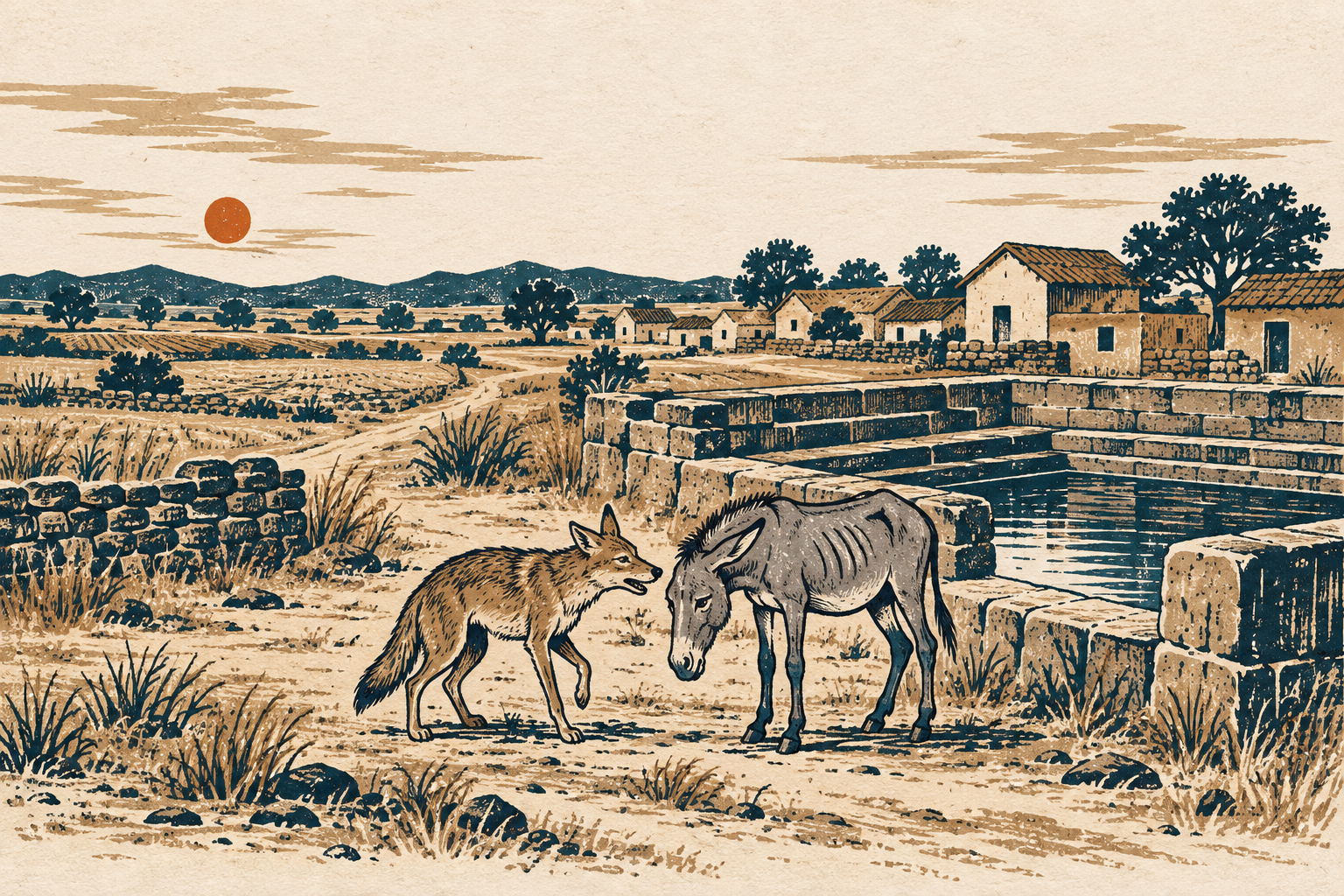
So the jackal went out to look, and his search took him all the way to the edge of a village, where he found a donkey named Lambakarna standing by a water-tank, tearing unhappily at a patch of thin, dusty grass. The donkey’s ribs showed, and he looked as though he had not had a full meal in some time.
“Well met, uncle,” said the jackal, drawing near. “It’s been a long while. What’s brought you so low?”
“My owner,” said the donkey, “who loads me past what I can carry and feeds me past what I can bear — which is to say, hardly at all. I eat what grows by the road, dust and thorns included, and there is never enough of it to keep flesh on my bones.”
“I know a stretch of riverbank,” the jackal said, “thick with green grass nobody’s touched, and a few good companions already settled there who’d welcome one more. No owner, no yoke. Come and see for yourself.”
The donkey’s ears went up at that, then fell again. “Tempting as it sounds, nephew, a village animal loose in wild country doesn’t last long. What use is your green bank to me if I’m eaten before I’ve had a mouthful?”
“No stranger sets foot there without my say-so,” the jackal said. “I see to that myself. Come on — you’ve nothing to lose by looking.”
And because he was hungry, and tired, and the promise cost him nothing to believe, the donkey went.
He followed the jackal a long way, right into the lion’s own territory, and the lion, flat on his belly with pain but watching every step through the undergrowth, could hardly believe his luck after so many hungry, useless days. He was so eager that he sprang before he was properly set, misjudged the distance entirely, and sailed clean over the donkey and crashed down on the far side of him. The donkey, feeling the wind of something enormous pass just above his head, did not wait to find out what it had been. He was back on the road to the village before the dust had settled, and he did not stop running until he reached it.
The jackal padded back to the lion, who lay where he’d landed, breathing hard. “That,” said the jackal, “was quite a performance.”
“I couldn’t set myself properly,” the lion said, embarrassed. “What was I meant to do — announce myself first? Bring him again.”
“He saw your whole self plainly and still got away,” the jackal said. “You think he’ll walk back into that a second time?”
“Then find me something else.”
“Give me a little credit,” said the jackal, and set off to track the donkey down.
He found him back at the same water-tank, tearing at the same thin grass, and looking, if anything, warier than before. “Nephew,” the donkey said, the moment he saw him, “that green bank of yours very nearly finished me. What was that creature? It came down like a falling tree and somehow missed me by nothing at all.”
The jackal let out a long-suffering sigh. “That,” he said, “was someone who’d been waiting there a good while, hoping to meet you — and rushed forward too fast, the way a person does when they’ve waited too long for something. You took fright and bolted before there was any harm done. But she’s taken it hard, uncle. Word is she’s utterly heartbroken over it, sitting by the water and refusing to be comforted, and I don’t like to think what a person in that state might do to herself. Come back with me, just to set it right, and let her see for herself that you’re unhurt. You’ll see there was never anything to run from.”
It is a strange thing about wanting to believe a story you have already been told once: the donkey had felt the danger himself, with his own body, not five minutes before, had heard the wind of it pass over his head and had run for his life without stopping to think — and still, hearing that someone was heartbroken on his account, and hungry, and worn thin by his owner besides, he let the jackal talk him round a second time, and set off after him once more.
This time the lion was ready and waiting, properly braced, and when the donkey came within reach there was no mistake made. It was over in a moment. The lion, satisfied, left the jackal to keep watch over the kill while he went down to the river to wash and say his prayers, as was his habit after any kill worth the name.
Left alone, the jackal helped himself to a good deal more than any fair share before his master returned — enough that when the lion came back, clean and unhurried, he stopped short at what he found and rounded on the jackal at once. “What is the meaning of this? You’ve eaten ahead of me — helped yourself first and left me the leavings!”
“My lord,” said the jackal, not missing a beat, “think it through. What kind of creature walks up to a lion, sees him plainly, runs for its life, and then — of its own accord — turns around and walks straight back into the same danger a second time? No animal with any sense left in it does that. Whatever I may have eaten first, I promise you he’d already lost the better part of it before I ever touched him.”
The lion turned this over, found it made a rough kind of sense, and — being no cleverer than he had been all along — let the matter drop. He shared out what remained, ate his portion without further suspicion, and never learned that he had been lied to twice in the same afternoon by the one creature he trusted to tell him the truth.
So the jackal kept both his stolen meal and his standing with his master, and paid nothing at all, then or ever, for either lie. That is the shape of a good lure: the first one only needs to get you looking; it’s the second one, the one that finds you already wanting to believe it, that walks you all the way back into the thing you had the sense to run from once.
Here, under our tree, the moth had finally given up on the lamp and gone off into the dark somewhere past the roots.
“He should have just stayed by the water-tank,” Leo said at last, quietly, for him.
“He should have,” Nani agreed. “But he was hungry, and someone told him exactly what he wanted to hear. That’s a hard thing to argue with, even when you already know better.”
Dev hadn’t said a word since the lion sprang the second time. He didn’t say one now either, just watched the space where the moth had been.
Bupam, tucked into a fork of the tree behind them, had already fallen asleep.
For the grown-up (not read aloud): the heart of it — the very thing that draws you can be the thing that ruins you, especially the second time, once you already want to believe it.
Where it comes from: retold from the Panchatantra (the lion, the jackal, and the donkey, Book 4), freely reshaped.
More stories for ages 9–12
The Monkey’s High Branch · The Frog King’s Bargain · The Judge Who Could Not Hear · The Narrow Way Out · Milk for the Anthill · The Friend Who Climbed the Tree
 Banyan Story Studio