


Little ones · ages 3–5 · comfortable from 3 with a grown-up · Retold from the Panchatantra
A heads-up: Early on, a thirsty herd of elephants accidentally tramples some rabbits on their way to drink. It happens quickly, before the story’s own action begins, and no one is hurt again after that.
Reading aloud? A note for you
Slow down for the naming beat at the start — it’s the same shape every evening, and that sameness is part of what makes it comforting. The heads-up above covers the one hard beat: the trampled rabbits are backstory, not something that happens in front of your listener, so you likely won’t need to say more than the heads-up already has. A child may ask why the rabbit lies about being the Moon’s messenger — you can say he’s using a clever pretend, the same kind used in games of make-believe, to keep his friends safe without a fight. There’s no fear held open for long: the elephant king is gentle and sorry almost as soon as he’s spoken to, and the story ends with everyone safe. Let “Not once” land quietly before you move on.
Leo had been crouched by the water bucket for a while, dropping pebbles in one at a time and watching the rings spread out and vanish before he dropped the next one, so absorbed that Nani had to call his name twice before he came and sat.
“Sorry,” he said, wiping his hands on his shorts.
Nani looked at each child in turn. “Mira, my Curious One, sitting up so straight. Leo, my Eager One — here at last. And Dev, my Careful One, right here by my knee.” Dev smiled without a word.
“Before the crows and owls came to war, a crow counsellor told his king these tales,” said Nani, “and tonight’s is one of them. It’s about a very clever rabbit, some very frightened friends, and a trick played with nothing but water and moonlight — a trick that did what all the strength in a whole herd of elephants couldn’t.”
“Listen.”
Long ago, deep in a forest, an elephant king named Chaturdanta ruled over a large herd. The rains failed for twelve long years, until every pond the elephants knew had turned to cracked, dry mud, and the elephant king sent scouts to find water.
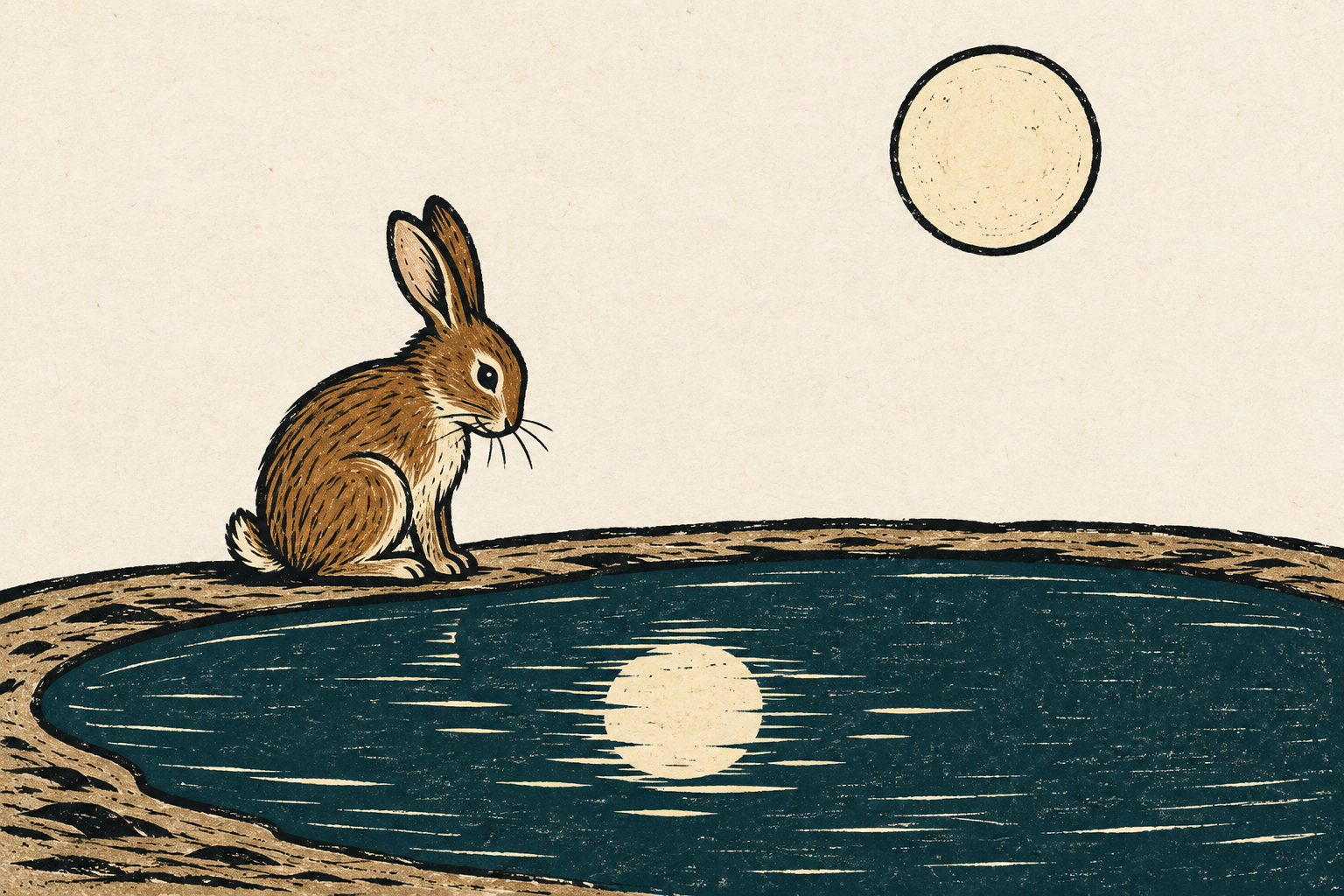
Far to the east, the scouts found a wide pool everyone called the Moon’s Pool, because at night the moon seemed to float on its surface. They hurried home with the news, and the elephant king led his herd there.
But the banks of that pool were home to thousands of rabbits, and when the herd pushed down to drink, so many huge feet pressed into the soft ground that many rabbits were hurt before the elephants knew they were there. Then, thirst gone, the herd turned around and went home.
The rabbits who had survived gathered together, frightened. “What if they keep coming back?” Nobody knew what to do — until one rabbit, Lambakarna, calm where the others were afraid, stepped forward. “Let me speak to them,” he said. “I promise: they will not come back.” The rabbit king trusted him and sent him on his way.
The rabbit knew better than to walk right up to an elephant king, so when the herd came back toward the pool, he climbed a tall, jagged rock, high enough that no elephant could reach him, and called down: “Greetings, mighty one.”
The elephant king stopped, startled. “Who is that?”
“I am an envoy of the Moon,” the rabbit answered. “You have hurt creatures who live in her own pool. Stop now, and all will be well. If you do not, great trouble will come to you.”
Hearing that he had angered the Moon herself, the elephant king’s heart went cold. “I have done a great wrong,” he said. “How can I make things right?”
“Come with me tonight, alone,” said the rabbit, “and I will show you.”
So that night, the elephant king followed him down to the still water, alone. There, floating on the surface, was the moon — round, bright, and whole.
“Kneel, and ask her forgiveness,” said the rabbit.
The elephant king lowered his head toward the water — and the moment his trunk touched it, the one calm moon broke apart into a hundred shivering pieces.
“Now you’ve done it,” said the rabbit, sounding alarmed. “You’ve touched her water — she trembles with anger, twice over!”
The elephant king bowed his huge head to the ground. “Beg her pardon for me,” he said. “I give you my word — I will never come here again.”
And he kept that word. He led his herd away and never returned, not once, for as long as he lived. The rabbits who remained were safe at last.
A clever pretend, carefully carried, had done what all the strength in that great herd never could: it kept a small, frightened people safe for good.
Here, under our tree, Leo reached for the bucket again out of old habit, then stopped himself and let it be.
“He never even touched him,” Leo said. “Not once.”
Nani nodded. “Not once.”
Bupam dipped one small paw into the bucket, just to watch his own ripple spread, then curled back up on the root beside them.
Mira sat turning something over, quiet for once. Dev sat quietly too, watching the water go still.
For the grown-up (not read aloud): the heart of it — a clever pretend can do what force cannot, and keep the small ones safe.
Where it comes from: retold from the Panchatantra (the rabbit who spoke for the Moon, Book 3).
More stories for ages 3–5
The Bird’s Golden Gift · Advice Nobody Asked For · The Hollow Drum
 Banyan Story Studio